Posts

Domesticated elephants of Punnathur Kotta in Kerala

Image
A tusker at Punnathur Kotta W atching the activities of an elephant or an ape is absolutely interesting to people of all age groups and of the entire world. While the African continent provides great opportunities for us to watch, very often in natural surroundings, all the wonderful wild life with special reference to elephants, the Indian subcontinent, particularly Kerala, can boast of its expertise in domesticating and maintaining these immaculate pachyderms. Guruvayur, the famous temple town in Kerala in Trichur District has the unique distinction of rearing and maintaining over 65 elephants- of which 58 are tuskers- in the yard at Punnathur Kotta . All these elephants belong to Lord Guruvayurappan -a synonym to Lord Krishna-the presiding deity of the ancient temple in Guruvayur. The temple authorities are responsible for the upkeep of these elephants. This place , about 3 km away from Guruvayur, is called Punnathur Kotta which used to be the abode of an ancient ruling family. I...

Hugh Crawford, Commercial Agent in Travancore during the19th Century

Image
Hugh and Mary Ann Crawford R eaders of my blog may have noted that, in February 2008, I wrote an article titled “Some Royal Correspondence.” It dealt with an original letter dated 4th January 1893 sent by Maharajah Moolam Thirunal Rama Varma of Travancore (AD 1885-1924) to Mr. John Rohde, of the erstwhile Travancore Civil Service while the latter had gone to England for his holidays. Therein I had discussed at length on the historical personalities named in the letter. I received a few mails from friends and readers on this article about which I felt very happy because it had created quite a bit of enthusiasm about the 19th century Travancore and some of its colourful personalities. But, the email received from Mr. Robert Collingwood from England was very special and most heartening to me because he happened to be the great great grand nephew of Jack (John) Rohde, who was the Commercial Agent to the Maharajah. “John Rohde, like most members of his family, was born in India, as the son...

Sir Albion Raj Kumar Banerji, I.C.S.

Image
Autograph of Sir AR Banerji ICS D uring the early eighties, I was working as the manager of one of the branches of a nationalized bank in India, beside the Banerji Road in Eranakulam. Despite my work of almost five years in that address, little did I know about “Banerji” except that he was a Diwan of Cochin. Very little information is obtained from the books published in Kerala or India about this distinguished ruler and civil servant who had some of the most important assignments in British India as a member of the elite Indian Civil Service. It does not speak well of us as Indians or Keralites that we know very little of our people and heritage and that after sixty years of independence a lot more work needs to be done on events and personalities of yore. Sir Albion Raj Kumar Banerji (1871-1950) was the son of Sasipada Banerji who was a doyen of the Brahmo Samaj (The Society of God) founded by Raja Rammohun Roy in AD 1828 and a great social reformer in his own right. Sasipada Baner...

A wonderful evening with the Tharakans of Thekkanattu Parayil.

Image
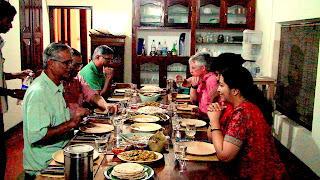
Jacob, Abraham and Anto Tharakans are on the left I was pleasantly surprised when Mr. Abraham Tharakan sent a mail presuming that I was in Kerala and then inviting us over to the Tharakan home in Olavipe. From my ancestral home in Chenganda in Cherthala, the tiny beautiful hamlet of Olavipe is not far away. I presume that before the land reforms came, the entire Olavipe might have belonged to the Tharakan family. The title “Tharakan” seems to have been given to this ancient and aristocratic family of Syrian Christians by Maharaja Marthanda Varma (AD 1706-58), the founder of modern Travancore.The Maharajah was ably assisted in conferring such titles by his selfless Diwan (Prime Minister) Ramayyan Dalawa. My wife Sindhu and son Mithun accompanied me to the Tharakan estate some 15 kilometers away through the country roads. The landscapes had not changed much over the last few decades and I could show the NSS College at Pallippuram to my wife where I had spent 5 years of my college life ...

Holidaying in Kerala

Image
Nalukettu , a partial view of my ancestral home in Cherthala S ummer in Kerala is quite sultry and I normally do not prefer to visit the place during April to May while working outside Kerala. By the first week of June, the south west monsoon erupts and the whole landscape changes drastically in the torrential downpour. This indeed is a great time for indoors. This time, the visit was inevitable during April as I was changing my job and had a good month’s time to visit Kerala traveling from Dubai. In someway, this intermission is a relaxing time and in certain other way, it is a time of anxieties. But, that is the way the Good Lord has intended one’s life to be! Visiting parents in Cherthala, attending the engagement of a nephew and going over to Chennai to see my daughter Lavanya, the budding and most demanding architectural student, occupies considerable time. Some torrential pre-monsoon rains, Elephants of Punnathoor Kotta, a mesmerizing musical evening of Pundit Shivkumar Sharma at...

Suttee, an eyewitness's account from AD 1824

Image
An old painting on Suttee S ati , (it means, a chaste woman. Suttee is an English corruption of this word)) was the ancient practice among some north Indian Hindu communities in which the widowed woman immolated herself in the husband’s funeral pyre. The barbaric custom existed over two millennia till the early part of the 19th century. Though many attempts, over centuries, had been made to forbid the practice, it was Lord William Henry Cavendish-Bentinck, the Governor General of India between AD 1827 and 1835, who passed a regulation ,despite fierce opposition, and declared that all who abetted Suttee were “ guilty of culpable homicide.” Widow sacrifice has not been peculiar to India alone. E. B. Tylor in his Primitive Culture has provided evidences of such rites among all primitive Aryan nations. The purpose of this note is not to dwell on the history or the other ritualistic aspects of Suttee, but to bring to the notice of the readers of an eyewitness’s account of an actual rite ...

Travancore and the Great Exhibition of London AD 1851

Image
The Great Exhibition , London AD 1851 Curious about the documents pertaining to Travancore history, I chanced upon an original print of the Illustrated London News of 31st January 1852, which featured the engraving of the reception by HH Maharajah of Travancore to the Letter from HM Queen Victoria. The above photo shows the sketch of the Durbar in which the then Maharajah of Travancore, HH Uthram Thirunal Marthanda Varma receives the letter of HM the Queen Victoria from the British Resident , Major General W. Cullen. The reception took place on 27th November 1851. A report on the function, as it appeared in the Illustrated London News also is shown . The details on the same could be summarized as under: Around AD 1850, Prince Albert, the Royal Consort of Queen Victoria, conceived the idea of a great Exhibition in London, primarily to showcase England as the leader of the industrial revolution. Also the exposition was intended to project the military, economic and technological prowe...